

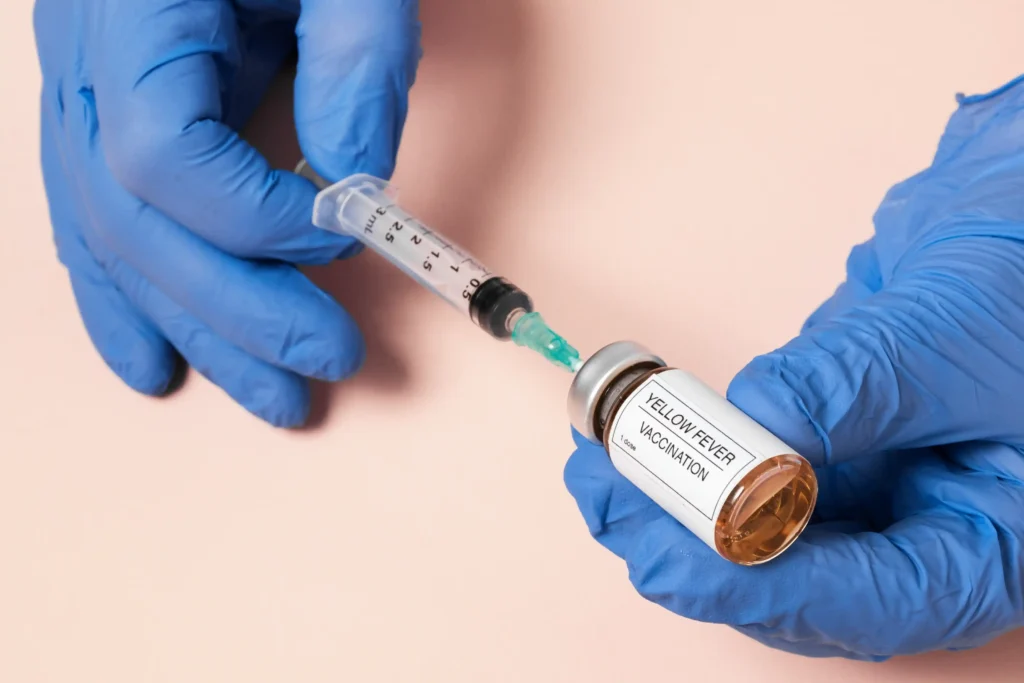
Some countries in sub-Saharan Africa and South America require proof of yellow fever vaccination for entry. This applies to all travellers, regardless of where they are coming from.
Many other countries have conditional entry requirements. If you are arriving from or even transiting through a country with a known risk of yellow fever, you must show a valid yellow card at the border.
The certificate needs to be on official ICVP paper. It becomes legally valid 10 days after vaccination. Many travellers don’t know about age rules, medical waivers, and the certificate’s lifetime validity.
Read on for the full breakdown, including country lists, transit traps, and what to do if you cannot receive the vaccine.
Table of Contents
“Yellow Card” (ICVP) Explained
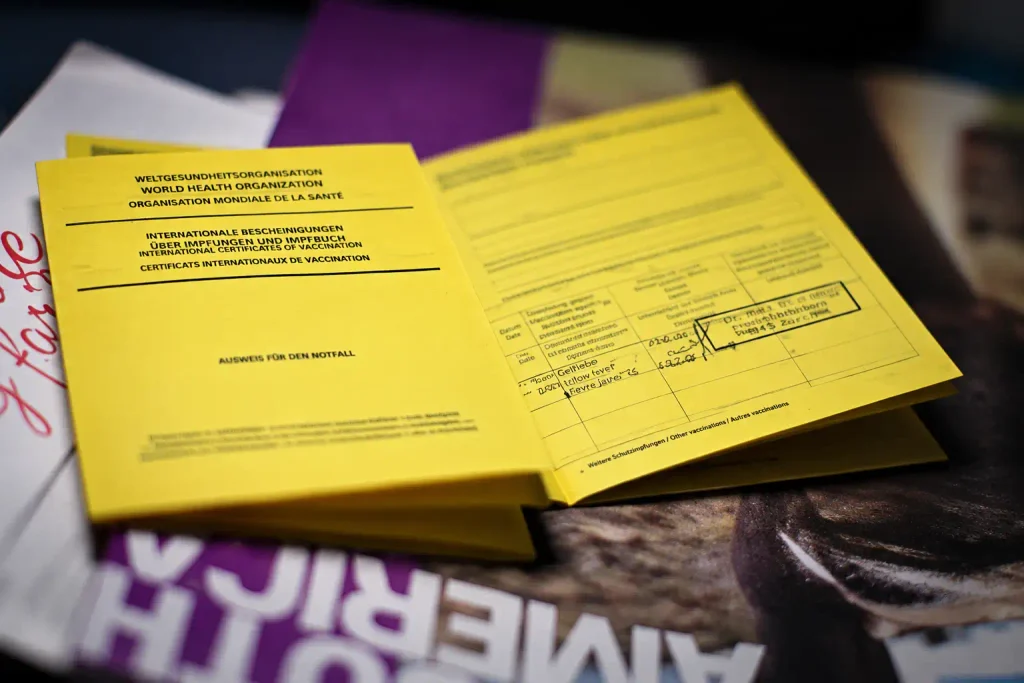
A yellow fever certificate is the International Certificate of Vaccination or Prophylaxis. It’s often called the ICVP or the “Yellow Card”.
This is not a printed sheet from your GP or a digital record on your phone. It’s a standard document given only by approved yellow fever vaccination centres, like registered travel clinics.
Two important facts about this certificate:
- The certificate becomes legally valid 10 days after your vaccination. It is not active immediately. If your flight is tomorrow and you have not been vaccinated yet, you cannot use a same-day jab to meet border requirements.
- A lost or damaged yellow card is a problem. Border officials will not accept a photocopy or a verbal explanation. Always keep the original in your travel documents.
Why Do Some Countries Require Yellow Fever Vaccination?
Yellow fever is a viral haemorrhagic fever spread by mosquitoes, primarily the Aedes aegypti species. It is endemic in parts of tropical Africa and South America. It triggers local transmission quickly once it enters a country with a vulnerable mosquito population.
Countries that require vaccination are essentially protecting their own populations. If a traveller arrives infected and gets bitten by a local mosquito, the disease can spread.
Some countries have completely eradicated the risk. Others sit on the edge of endemic zones and enforce strict entry rules to stay that way.
Countries That Require Yellow Fever Vaccination for Entry

These countries require a valid Yellow Card from all arriving travellers, regardless of where they are coming from:
- Angola
- Burundi
- Cameroon
- Central African Republic
- Chad
- Cote d’Ivoire (Ivory Coast)
- Democratic Republic of Congo
- Equatorial Guinea
- French Guiana
- Gabon
- Ghana
- Guinea
- Guinea-Bissau
- Liberia
- Mali
- Mauritania
- Niger
- Nigeria
- Republic of Congo
- Rwanda
- Sierra Leone
- Togo
- Uganda
- Zambia
- Benin
- Burkina Faso
- South Sudan
- São Tomé and Príncipe
This list is illustrative of countries with mandatory requirements and is not exhaustive. Check TravelHealthPro for the latest route-specific requirements before you travel. Border rules change often.
Note: French Guiana is an overseas department of France. In Brazil, the state of Piauí is now a risk area. Salvador is no longer on the list of areas where vaccination is not recommended.
Conditional Requirement: The “Origin and Transit” Rule

This is where many travellers get caught out.
The rule: You must show a yellow card if you come from a country with yellow fever risk, even if vaccination isn’t required for everyone.
The transit trap: Transit rules vary by country. While many use a 12-hour threshold, this is not universal; some countries require a certificate for any duration of airport transit in a risk zone. Additionally, a certificate may be required if you arrive in a non-endemic country within 6 days of leaving a risk area.
Countries with high travel volumes that enforce this rule include:
- South Africa
- Kenya
- Tanzania
- Egypt
- Thailand
- India
- Australia
If you flew through Lagos, Nairobi, or Caracas before landing there, you will need your certificate ready.
A common scenario: a UK traveller flies from London to South Africa with a 14-hour layover in Accra, Ghana. Ghana is on the list of countries requiring a yellow fever certificate. South Africa may require a valid yellow fever certificate.
Age Rules for the Vaccine
The rules are not the same for everyone. Age matters.
The 9-month threshold: Under UK Patient Group Direction (PGD), 9 months is the absolute minimum age for vaccination. Vaccination is not an option for infants under this age.
Infants under 6 months: The vaccine should never be given to babies under 6 months old due to the risk of encephalitis. This is an absolute contraindication, not a matter of preference.
Babies aged 6 to 8 months: These infants usually pass through border control without issues. However, it’s best to keep them away from areas with high exposure risk where possible. Even when vaccination is not required for entry, exposure can still pose a risk to the child.
Country variations: Some countries, including Kenya, require vaccination starting at 1 year of age rather than 9 months. Always check the specific entry rules for your destination, not just the general WHO guidance.
Medical Waivers for Unvaccinated Travellers

If someone can’t get vaccinated because of a serious medical condition, they can apply for a formal exemption.
Absolute Exclusions: The vaccine is not for those with thymus disorders, such as myasthenia gravis or thymoma. It’s also off-limits for anyone who has had a thymectomy, even if it was done during heart surgery.
Other exclusions are:
- Pregnancy or planning to conceive within 28 days
- Breastfeeding an infant under 9 months
- Latex or egg anaphylaxis
- Acute severe febrile illness
- A first-degree family history of YEL-AVD or YEL-AND
Age 60+: The WHO does not recommend the vaccine for those aged 60 or over due to the increased risk of serious adverse reactions.
The process: A registered Yellow Fever Vaccination Centre (YFVC) can issue an exemption letter. This happens after a complete clinical assessment. GP surgeries that are not registered YFVCs cannot issue valid exemption letters.
Border acceptance: Acceptance of a medical waiver is at the sole discretion of the destination country and cannot be guaranteed. Travellers may still face health monitoring or quarantine.
The Lifetime Validity Rule
This is one of the most misunderstood rules in travel health, and it trips up travellers who received their vaccine before 2016.
The old rule: Before 2016, yellow cards needed to be renewed every 10 years. Many cards issued before that date have a printed expiry date.
The current rule: In 2016, the WHO amended the International Health Regulations. A single dose of the yellow fever vaccine is now considered to provide lifelong immunity. Your yellow card is valid for the rest of your life, regardless of any expiry date printed on it.
What this means in practice: If you have an old yellow card with a printed expiry date of 2019, it is still legally valid. You generally do not need a new vaccination. Border officials in countries that follow the current rule should accept it. If you’re going to a place with strict rules, a letter from a travel clinic about the 2016 rule change can help you avoid delays at the border.
Booster Exception
A single dose usually gives lifelong protection. However, a clinician may suggest a booster if the first vaccine was given when the person was under 2, during pregnancy, or if they were immunosuppressed or HIV-positive.
Vaccine Scheduling
If you need other live vaccines, remember to wait at least 4 weeks after getting the yellow fever vaccine before getting the MMR or dengue vaccines.
Frequently Asked Questions
Can I get the yellow fever vaccine at my NHS GP?
No. The yellow fever vaccine is only available at approved yellow fever vaccination centres. Your NHS GP surgery is unlikely to be one. You need to book through a registered travel clinic.
How long before travel should I get vaccinated?
At least 10 days before departure, as the certificate is not valid until 10 days post-injection. Booking 4 to 6 weeks ahead gives you enough time if other travel vaccines are needed alongside it.
Does the UK issue yellow cards?
Yes. UK-approved yellow fever centres issue the official ICVP. The certificate is accepted internationally. Private travel clinics registered with the National Travel Health Network and Centre (NaTHNaC) can issue it.
What happens if I arrive without a yellow card and the country requires one?
You may be refused entry, vaccinated at the border at your own cost, or placed in quarantine. The outcome depends on the country and its current enforcement policy. It is a risk not worth taking.
Is South America also included in the mandatory requirement list?
French Guiana is the only South American country that requires proof from all travellers. Countries like Brazil, Peru, and Bolivia suggest that travellers get the vaccine if they visit certain areas. However, they do not require a certificate at the border.
Conclusion
Yellow fever entry requirements are in two groups: mandatory for all travellers and conditional based on your origin.
Over 20 countries in Africa, plus French Guiana, require a valid yellow card from everyone. Many places, like South Africa, Kenya, and Thailand, will require it if you’ve been in a risk zone, even for a short time.
The certificate must be on official ICVP paperwork and is only valid for 10 days after your injection. Since 2016, one dose gives lifelong protection. You don’t need a booster, even if your old card shows an expiry date.
If you cannot be vaccinated for medical reasons, a formal waiver letter from an approved clinic is your best option. Visit a registered travel clinic early before your trip. This way, you can confirm what you need for your specific itinerary.