

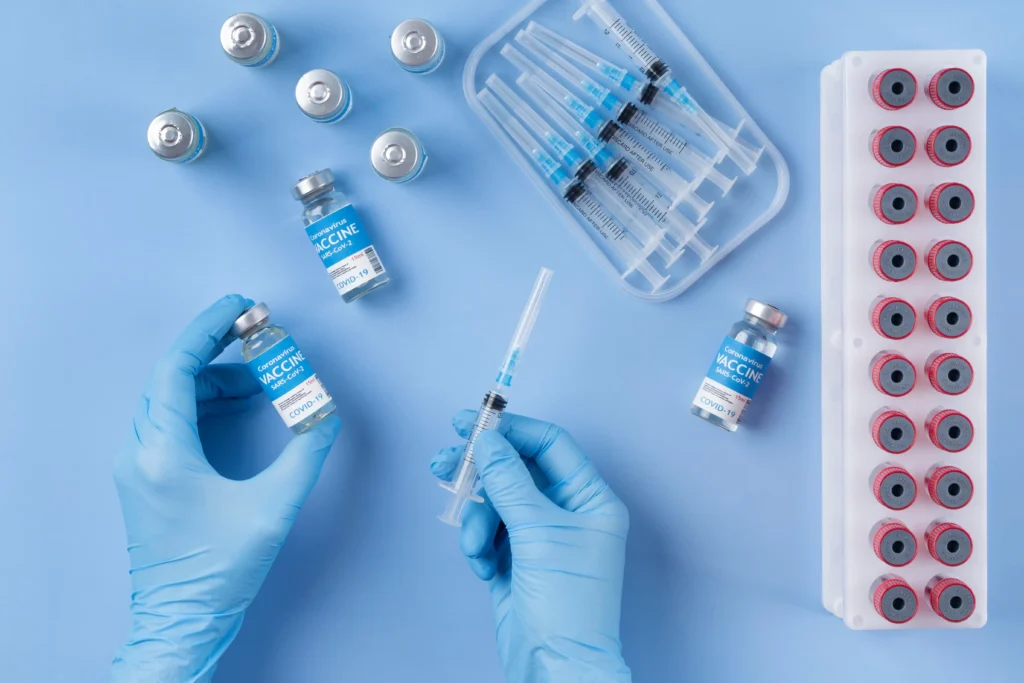
Yes, multiple travel vaccines can be given together in a single travel clinic visit. This is standard practice in UK travel medicine and is supported by Public Health England guidance and the Green Book. The main exception involves live vaccines like Yellow Fever and MMR: if you need two live vaccines and they are not given on the same day, you must wait at least 28 days between them.
For the full picture on timing rules, side effects, and who needs extra care, read on.
Table of Contents
Can You Safely Get More Than One Travel Vaccine at Once?

This is one of the most common questions we hear at the travel clinic. Patients worry they’ll be asking too much of their immune system by having three or four injections in one sitting.
That worry is understandable, but it’s not backed by the science.
Your immune system is exposed to thousands of antigens every single day. A course of travel vaccines introduces a tiny fraction of that. The NHS, the World Health Organization, and the Green Book all confirm that receiving multiple vaccines simultaneously does not reduce their effectiveness or increase the risk of serious reactions.
Getting everything done in one visit is not a shortcut. It is the recommended approach.
Which Travel Vaccines Are Commonly Given Together?
Several combinations are given routinely on the same day. The most common ones we see are:
- Hepatitis A and Typhoid (often available as a single combined injection, Vivaxim)
- Hepatitis A, Typhoid, and a Tetanus/Diphtheria/Polio booster on the same visit
- Hepatitis B alongside Hepatitis A, particularly for longer trips or working travel
- Meningitis ACWY and Rabies in the same appointment for higher-risk destinations
When more than one injection is needed in the same arm, we space them at least 2.5 cm apart. Where possible, we use separate arms to keep any local soreness manageable.
Live vs Inactivated Vaccines: Why It Matters
Not all vaccines work the same way, and understanding the difference will make the timing rules below much clearer.
Inactivated vaccines
Inactivated vaccines use killed or fragmented versions of a pathogen. Hepatitis A, Hepatitis B, Typhoid (injectable), Rabies, and the Meningitis ACWY vaccine are all inactivated. These can be given at any interval alongside each other, or alongside live vaccines, without any restrictions.
Live attenuated vaccines
Live attenuated vaccines contain a weakened but living version of a virus. Yellow Fever, MMR, and the oral Typhoid capsules fall into this category. Because they replicate briefly in the body to generate immunity, two live vaccines given at different times (but not simultaneously) can interfere with each other.
That interference is why the 28-day rule exists. It’s not a precaution plucked from thin air. It is based on decades of immunological data.
When Vaccines Cannot Be Given Together

The headline rule: if you need two live vaccines, give them on the same day or wait at least 28 days between them.
Yellow Fever is the most common live vaccine in travel medicine. If you also need MMR or oral Typhoid capsules, the options are straightforward. Either we administer all live vaccines at the same appointment, or we schedule them with a clear 28-day gap.
Inactivated vaccines are not affected by this rule at all. A Hepatitis A jab can be given the day after a Yellow Fever jab without any concern.
One practical point: oral Typhoid capsules (Vivotif) should be taken at least three days before or after antibiotics, as antibiotics can reduce their effectiveness. This is separate from the live vaccine spacing rule but worth knowing if you’re also taking malaria tablets or antibiotics for other reasons.
What to Expect: Will Your Side Effects Be Worse?
Having four vaccines in one visit does not mean you will feel four times worse. Systemic reactions like fever or fatigue are driven mainly by your immune system’s response, and that response is not additive in the way people assume.
What you will likely notice is soreness in two arms instead of one. Possibly a small red patch or firmness where each injection was given. This is normal and usually settles within two to three days.
Practical things that genuinely help:
- Keep the arms moving gently after the visit. Stiffness is worse if you hold the arm still.
- Drink plenty of water on the day.
- Paracetamol is fine if the soreness is uncomfortable.
- Avoid vigorous exercise for 24 hours, particularly if you’ve had Yellow Fever.
Serious reactions to travel vaccines are rare. Anaphylaxis occurs in roughly 1 to 2 per million doses across all vaccines. Our clinic staff are trained to manage this, and we ask patients to wait for 15 minutes after Yellow Fever specifically.
Planning Your Vaccination Schedule
The single biggest mistake travellers make is booking a travel clinic appointment too late.
Book at least 4 to 6 weeks before departure. Some vaccines, like the full Hepatitis B course (three doses over six months), cannot be rushed meaningfully. Others, like Hepatitis A, give solid protection within two weeks of the first dose. Yellow Fever provides lifelong protection for most people after a single dose, but UK ATAGI guidance still recommends allowing at least 10 days before entry to certain countries.
If you need live vaccines and inactivated vaccines, and there is a timing conflict, we can usually work around it by prioritising the live vaccines first.
If you’re travelling in under two weeks, come in anyway. We can work with what time is available and prioritise accordingly.
Special Considerations for Certain Travellers

Older Adults (Over 60)
There is no upper age limit for travel vaccines, and older adults should not skip vaccination because of age alone. That said, immune responses can be slightly less robust in older age, and Yellow Fever carries a marginally higher risk of serious adverse events in people over 60 who have never had the vaccine.
We discuss this carefully before administering it. For most destinations and most travellers over 60, the risk of Yellow Fever disease far outweighs any vaccine risk.
Immunocompromised Individuals
If you are on immunosuppressant medication, biological therapy, or are living with HIV with a low CD4 count, live vaccines may be contraindicated. This includes Yellow Fever and oral Typhoid. Inactivated vaccines are generally safe but may produce a weaker immune response. We will review your medication list and consult your GP or specialist if needed before proceeding.
Pregnant Women
Yellow Fever vaccine should be avoided in pregnancy unless travel to a high-risk area is unavoidable. Most inactivated vaccines are considered safe, and influenza vaccination is actively recommended during pregnancy. We will review your full situation and advise you individually.
Children Under 9 Months
Yellow Fever is not licensed for infants under 6 months, and is used with caution between 6 and 9 months. The standard childhood immunisation schedule already covers some travel-relevant diseases (MMR, Hepatitis B in some groups). We will map out what’s already covered and what still needs doing.
Frequently Asked Questions
Can you get yellow fever and typhoid vaccine together?
Yes, if you’re having the injectable typhoid vaccine (Typhim Vi), it can be given on the same day as Yellow Fever without any timing restriction. The oral typhoid capsules (Vivotif) are a live vaccine, so they should ideally be given on the same day as Yellow Fever or at least 28 days apart.
Can you get all travel vaccines at once if you’re departing in less than two weeks?
Mostly yes. Most inactivated vaccines can be given together immediately. If live vaccines are involved and there is insufficient time to separate them, we give them simultaneously in the same visit to avoid the interference window.
Is there a maximum number of travel vaccines that can be given in a single appointment?
There is no official upper limit. Practically, most adults receive between two and five injections in a single visit without any issue. We typically limit to what can comfortably fit in two arms.
Can you get the rabies vaccine at the same time as other travel vaccines?
Yes. Rabies (Rabipur or Verorab) is an inactivated vaccine and can be given alongside any other travel vaccine on the same day. It’s given as a three-dose course over 21 to 28 days, so you’ll have multiple appointments regardless.
Do travel vaccines interact with malaria tablets?
Doxycycline and Malarone do not affect injected vaccines. However, doxycycline and chloroquine can reduce the effectiveness of the oral Typhoid capsules (Vivotif). Finish the Vivotif course at least three days before starting doxycycline if both are needed.
Conclusion
Getting multiple travel vaccines in a single visit is safe, effective, and the approach we actively recommend for most travellers. The key distinctions to remember are the live versus inactivated split and the 28-day rule that applies when two live vaccines are needed separately. Side effects are usually limited to local soreness. Book 4 to 6 weeks ahead where possible, and come in even if time is short.
If you have specific health conditions or are unsure which vaccines apply to your destination, speak to one of our travel health team. We will build a schedule that protects you without unnecessary complexity.